 Systemizer Technic
"$100,000. That's the average cost of one hour of infrastructure downtime."
We automate the work that causes it.
— IDC survey spotlight, Jan 2021
Automation entails leveraging technology to streamline and execute tasks or processes without direct human intervention. While commonly employed in sectors such as manufacturing, robotics, and vehicle control, its significance in IT cannot be overstated.
In the realm of information technology, automation involves utilising instructions to establish a repetitive process that supplants manual labour by IT professionals in data centers and cloud deployments. Automation tools, frameworks, and appliances operate tasks with minimal administrator involvement. The spectrum of IT automation spans from singular actions to defined sequences and, ultimately, to self-sufficient IT deployments that respond to user interactions and other triggers.
As a cornerstone of IT optimisation, embracing automation is not merely a forward-thinking strategy but a fundamental necessity for any business striving to remain relevant, secure, and efficient in today’s digital age. Automation enhances efficiency, consistency, and scalability, enabling organisations to achieve greater operational excellence.
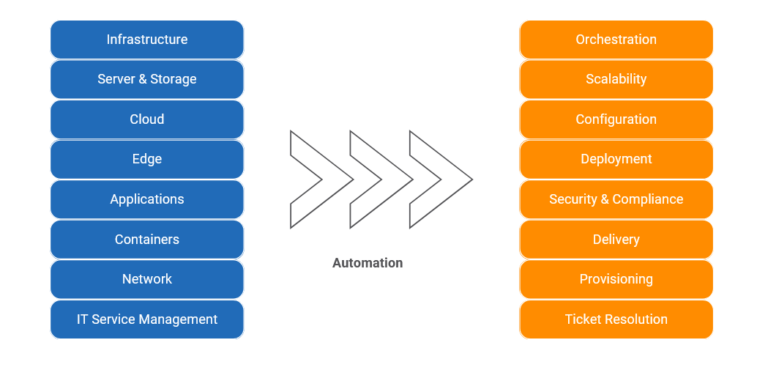
IT automation simplifies and speeds up tasks in the IT environment using tools like Ansible with playbooks to automate processes like provisioning virtual machines and managing backups. Enterprise-level automation tools can respond to events, configure systems, detect unauthorized changes, and maintain server configurations automatically, improving efficiency and reliability in IT operations.
Discovery
Start by understanding your environment, and goals to identify where automation delivers the most value.
Implementation
Design, build, and deploy automation for your operations, with clear documentation and collaboration throughout.
Support
Gain access to around the clock technical support to ensure everything runs smoothly and reliably.
Training
Be part of the program. Train your team to use, understand, and expand the automation initiative.
Every step of the way.
Drawing on our expertise in automation and strategic technology collaborations, we are a leading
No matter how intricate your setup is or where you stand in your IT modernisation process, our automation tool is prepared to assist you at every stage.
- Speed up operations and development
- Improve agility and responsiveness
- Boost productivity and efficiency
- Ensure consistency and availability
- Strengthen security and compliance
- Free up staff time for important projects
- Drive cost savings throughout your organisation

When you choose to start your Automation journey, we guide you through our process and accompany you at every stage.

Where ST-Automation Delivers Impact
We focus on automation that brings immediate value with minimal complexity. These are common starting points for many of our customers.
DR Automation
Automate disaster recovery steps for faster failover and easier testing. Reduce downtime and improve readiness.
System Patching And Updates
Keep your servers secure and consistent by automating patch cycles across the environment.
Configuration Drift Detection
Ensure systems and network devices stay aligned with approved settings. Automatically detect and correct changes.
User And Access Management
Automate the creation, modification, and removal of user accounts and permissions to reduce delays and errors.
Cloud Resource Scheduling
Lower your cloud bill by automatically shutting down or starting resources based on time or workload needs.
Security Audit And Compliance Checks
Run scheduled audits to check system configurations, security baselines, and compliance status. Get clear reports without manual effort.
Provisioning Of Infrastructure
Speed up delivery of servers, containers, and network setups using automated templates built to your standards.
Automation is not just about speed. It’s about gaining control, reducing risk, and freeing up your team to focus on what matters most.
- Fewer errors, more consistency
Manual work leads to mistakes. Automation makes your operations easily repeatable and reliable. - Faster delivery
Tasks that used to take hours or days can now be completed in minutes, with no waiting. - Improved security and compliance
Automated patching, audits, and access control help you stay secure and compliant without relying on manual checks. - Lower operational costs
Save time, avoid rework, and reduce dependency on manual effort. Automation pays for itself over time. - Better use of your team
Free up your engineers from routine tasks so they can focus on more valuable work.
‘
The average hourly cost of an infrastructure failure is $100,000 per hour, a survey of the Fortune 1000 by IDC finds. In addition, the average total cost of unplanned downtime per year is $1.25 billion to $2.5 billion. The financial impact may pale in comparison to the reputational risk and cost of lost customers, let alone potential regulatory sanction.
IDC survey spotlight, Jan 2021
Automating disaster recovery (DR) have many benefits, including expedited recovery times, enhanced dependability, cost savings, and improved regulatory adherence.
By automating the processes, the restoration of systems and data can be accomplished within minutes or hours rather than the traditional span of days or weeks. The utilisation of predefined scripts and templates mitigates the risk of human errors and inconsistencies. In fact, most misconfigurations are introduced through inadvertent human mistakes.
Automation also provide audit trails, reports, and alerts, facilitating adherence to regulatory and industry mandates such as the Risk Management in IT (RMiT).

When developing a disaster recovery (DR) plan, assessing the technology stack is crucial. Collaboration among subject matter experts (SMEs) at each layer is necessary. Manual operations can prolong recovery time, while automation allows for more frequent testing and faster restoration.
Systemizer Technic provides tools and training for effective DR Automation strategy implementation, enhancing efficiency and accuracy while saving costs and building trust in organisational capabilities.

Each of these layers has their own SME who will need to work in tandem to address complexities and challenges during a DR event

Time Savings: Traditional disaster recovery often involves manual processes and large teams, leading to costly downtime. Automating recovery reduces downtime by quickly restoring vital systems. Integrating tools like CMDB expedites the process.

Measurable Analytics: Automation provides valuable analytics for improving recovery efficiency. IT teams can track performance, set realistic goals, and identify areas for improvement based on data from DR testing.

Reduced Compliance Risk: Industries like finance must prove effective recovery strategies to avoid fines and downtime costs. Automated audit trails simplify compliance by providing detailed records without post-event reconstruction

Heightened Productivity: Automated failover to secondary data centers maintains revenue generation during primary system downtime, reducing the impact of outages. It ensures critical systems remain operational, maintaining business continuity and reducing outage costs.
Download The Control Gap — our free 12-page guide — or take the free 5-minute IT Readiness Assessment for a personalised report mapped to your team’s specific gaps.